
Can a Liability Waiver Defeat an Amusement Injury Lawsuit?
Why the Answer Is Often More Complicated Than the Waiver Suggests
Trampoline parks, ziplines, aerial adventure courses, indoor playgrounds, climbing attractions, and other amusement facilities commonly require participants—or parents signing for minor children—to execute liability waivers before participating.
When an injury occurs, the waiver may become one of the first issues evaluated by attorneys on both sides.
For an injured patron, the existence of a signed waiver can initially appear to present a major obstacle. For an operator or insurer, it may appear to provide a strong defense.
But a signed waiver does not necessarily end the analysis.
The enforceability and scope of recreational liability waivers vary substantially by jurisdiction and depend upon the language of the agreement, the circumstances under which it was executed, the risk that actually caused the injury, and—critically—the conduct of the amusement operator.
In serious amusement injury cases, the more important question may therefore be:
What exactly happened, and is that conduct something the participant could legally and effectively waive?
Liability Waivers Are Governed Primarily by State Law
There is no single nationwide rule governing recreational liability waivers.
State law generally determines whether an exculpatory agreement is enforceable, and the rules can vary considerably from one jurisdiction to another.
Some states are relatively receptive to recreational releases covering ordinary negligence. Colorado, for example, has recognized that recreational businesses generally are not providing essential public services and may, under appropriate circumstances, contract against liability for ordinary negligence.
But even jurisdictions that recognize recreational waivers impose limitations.
Courts may examine such issues as:
-
whether the waiver clearly communicates the rights being released;
-
whether its language is ambiguous or excessively broad;
-
whether important provisions are sufficiently conspicuous;
-
whether the agreement specifically addresses the risk involved;
-
whether the waiver violates state statutes or public policy; and
-
whether the operator's conduct exceeds the type of ordinary negligence that may legally be released.
That last issue can become particularly important in amusement injury litigation.
A Waiver of Ordinary Negligence Is Not Necessarily a Waiver of More Serious Misconduct
One of the most important distinctions in waiver litigation is the difference between ordinary negligence and more serious conduct such as gross negligence, recklessness, willful misconduct, or intentional wrongdoing.
Courts generally impose significant public-policy limitations on attempts to contract away responsibility for conduct beyond ordinary negligence.
This creates an important investigative issue in amusement cases.
Consider the difference between an unexpected operational mistake and evidence showing that an operator:
-
repeatedly failed to perform required inspections;
-
knew that safety equipment was defective but continued operating the attraction;
-
ignored manufacturer warnings or safety bulletins;
-
operated equipment contrary to manufacturer requirements;
-
failed to implement required safety systems;
-
knowingly departed from established industry safety practices;
-
inadequately trained employees responsible for safety-critical functions; or
-
continued operating after becoming aware of a dangerous condition.
The legal characterization of those facts depends upon the jurisdiction and circumstances. But evidence of repeated, knowing, or substantial safety failures may become relevant to whether the alleged conduct falls outside the protection of an otherwise enforceable waiver.
That is one reason the technical investigation can be just as important as the language printed on the waiver.
ASTM Standards and Manufacturer Requirements Can Become Important Evidence
In amusement litigation, determining what the operator should have done frequently requires understanding the industry's technical and operational standards.
Depending upon the attraction, relevant evidence may include:
ASTM F24 standards for amusement rides and devices
Manufacturer operations and maintenance manuals
Manufacturer service bulletins
Inspection requirements and inspection records
Employee training materials
Maintenance records
Incident and accident reports
Daily opening and closing procedures
Equipment specifications and engineering documentation
Applicable state and federal regulations
Industry standards and customs do not automatically determine liability. However, courts may permit evidence of industry standards and customs as evidence bearing upon the applicable standard of care.
This can make expert analysis particularly important.
An expert familiar with amusement operations can compare what actually occurred with the procedures, equipment configurations, inspections, training, and safeguards that should have existed.
The Difference Between an Inherent Risk and an Operational Failure
Another important issue is identifying the actual mechanism of injury.
There can be an important distinction between a risk inherent in an activity and a hazard allegedly created by improper design, maintenance, installation, supervision, or operation.
For example, falling while jumping on a trampoline is fundamentally different from an allegation involving:
-
exposed structural components;
-
inadequate padding;
-
improper trampoline-bed tension;
-
a gap between an attraction and surrounding platform;
-
defective or improperly installed equipment;
-
inadequate separation between participants;
-
improper court monitoring; or
-
failure to follow manufacturer operating requirements.
Likewise, a zipline participant may understand that ziplining involves speed, height, and physical forces.
That does not necessarily answer allegations involving:
-
improper harnessing;
-
incorrect braking configuration;
-
inadequate braking distance;
-
failure of a trolley, lanyard, connector, or braking component;
-
improper platform construction;
-
failure to inspect equipment;
-
inadequate employee training; or
-
continued operation of equipment after a known problem was identified.
Identifying the mechanism of injury can therefore become critical both to the underlying negligence analysis and to determining whether the event falls within the risks contemplated by the waiver.
Does the Waiver Actually Cover the Accident That Occurred?
Even when a jurisdiction permits recreational liability waivers, courts may scrutinize whether the agreement clearly encompasses the particular risk involved.
The memorandum reviewed by MIT Experts discusses Colorado decisions examining factors such as whether the agreement uses simple and clear language, whether it is excessively complicated, whether important provisions are emphasized, and whether the release specifically addresses the risk that caused the injury.
This presents another reason attorneys should resist evaluating an amusement case solely by asking whether the plaintiff signed a waiver.
Instead, compare the waiver with the actual accident mechanism.
If a trampoline waiver discusses ordinary risks associated with jumping and falling, for example, does that language clearly encompass an injury allegedly caused by a structural gap, equipment failure, or improper installation?
If a zipline release warns generally about heights and outdoor recreation, does it clearly address an accident allegedly caused by improper harnessing, braking-system failure, or a defective platform?
Those questions are jurisdiction-specific, but the underlying accident investigation can be essential to answering them.
Overly Broad Waivers Can Create Their Own Problems
Broader is not always better.
Some waivers attempt to release the operator from "any and all claims" or "all liability." Depending upon the governing law and drafting, sweeping language may create questions about ambiguity, public policy, and whether the agreement improperly attempts to encompass conduct that cannot legally be released.
Courts also differ on what happens when part of a waiver is impermissibly broad.
Some may sever problematic language and enforce the remainder. Others may decline to rewrite an overreaching provision for the party that drafted it.
Accordingly, attorneys should examine the exact waiver—not simply accept the characterization that "the plaintiff signed a release."
How the Waiver Was Presented May Matter
The substance of the waiver is only part of the analysis.
Its presentation can matter as well.
Courts in some jurisdictions consider whether the signer received adequate notice that he or she was surrendering significant legal rights.
Questions can include:
Was the waiver a separate document?
Was it clearly identified as a liability release?
Were important provisions emphasized?
Was it buried inside a registration agreement?
How much text appeared on the screen?
Was it signed on a kiosk, tablet, or smartphone?
Could the participant readily review the entire agreement?
Was the signer rushed through the process?
What did the facility's employees tell participants about the document?
These facts can become particularly relevant in modern amusement facilities where waivers may be completed rapidly on electronic kiosks while a family or group is waiting to enter an attraction.
For attorneys investigating these cases, preserving the actual version of the electronic waiver and the user interface through which it was presented may therefore be important.
Why Early Expert Investigation Can Matter
A waiver issue initially looks like a contract question.
But in an amusement injury case, determining whether the waiver ultimately applies may require a much broader factual and technical investigation.
An attorney may need to determine:
-
What actually caused the accident?
-
What safety standards applied?
-
What did the manufacturer require?
-
Was the attraction properly installed and maintained?
-
Were inspections properly performed and documented?
-
Were employees adequately trained?
-
Did the operator know about the hazard before the accident?
-
Were previous incidents or complaints reported?
-
Did the operator continue operating despite a known safety problem?
-
Does the risk described in the waiver actually correspond to the mechanism that caused the injury?
The answers may significantly affect the waiver analysis.
Evidence Attorneys Should Consider Preserving
When a waiver may become an issue in a trampoline park, zipline, aerial adventure, indoor playground, or amusement injury case, early preservation can be critical.
Potential evidence includes the waiver itself and its revision history; photographs and video of the attraction; surveillance footage; manufacturer manuals and service bulletins; inspection and maintenance records; employee training records; prior incident reports; repair records; internal communications concerning known hazards; state inspection records; applicable ASTM standards; and the equipment involved in the accident.
In serious cases, attorneys should also consider whether a prompt site inspection is appropriate before the facility repairs, replaces, reconfigures, or removes relevant equipment.
A Signed Waiver Should Be the Beginning of the Analysis, Not Necessarily the End
Liability waivers can be important defenses in recreational injury litigation. In some jurisdictions and under appropriate circumstances, they can bar claims based upon ordinary negligence.
But their effect should not be assumed.
Waiver enforceability may depend upon state law, public policy, the wording and presentation of the agreement, the particular risk involved, and the nature of the operator's conduct.
For amusement injury attorneys, this means the waiver and the technical accident investigation should often be evaluated together.
A participant may have agreed to accept certain inherent risks of an activity.
That is a different question from whether the participant legally released an amusement operator from responsibility for an alleged equipment defect, ignored manufacturer requirement, inadequate inspection program, improper installation, deficient employee training, or knowing disregard of an identified safety hazard.
Understanding that distinction can fundamentally change how an amusement injury case is evaluated.
How MIT Experts Can Help
MIT Experts specializes in accident investigation and expert witness services involving trampoline parks, ziplines, aerial adventure attractions, indoor playgrounds, amusement rides, and related recreational facilities.
Our work includes evaluating accident mechanisms, equipment configurations, ASTM and industry standards, manufacturer requirements, inspection and maintenance practices, employee training, operational procedures, and other technical issues relevant to determining whether an amusement facility complied with the applicable standard of care.
When a liability waiver is involved, that technical investigation may help counsel determine whether the accident involved an ordinary inherent risk—or evidence of safety failures that require a substantially different legal analysis.
If your firm is evaluating an amusement injury case involving a liability waiver, MIT Experts can assist with early case review, evidence preservation, site inspections, standards analysis, and expert testimony.
This article is provided for informational purposes only and does not constitute legal advice. Liability-waiver law varies significantly by jurisdiction and attorneys should evaluate the statutes and controlling case law applicable to the particular case.

Written By Peter Jay
Authored by seasoned professionals with extensive experience in amusement industry operations and legal expertise, providing authoritative perspectives on complex injury cases.
Explore More Expert Insights
Indoor Playground Injuries Are Not Trampoline-Park Cases: Why ASTM F1918 Is Usually the Standard That Actually Applies
Indoor Playground Injuries Are Not Trampoline-Park Cases Why ASTM F1918 is usually the standard that actually applies When a child is injured in a padded, enclosed play structure at a family entertainment center, mall play area, or indoor playground, the file often...
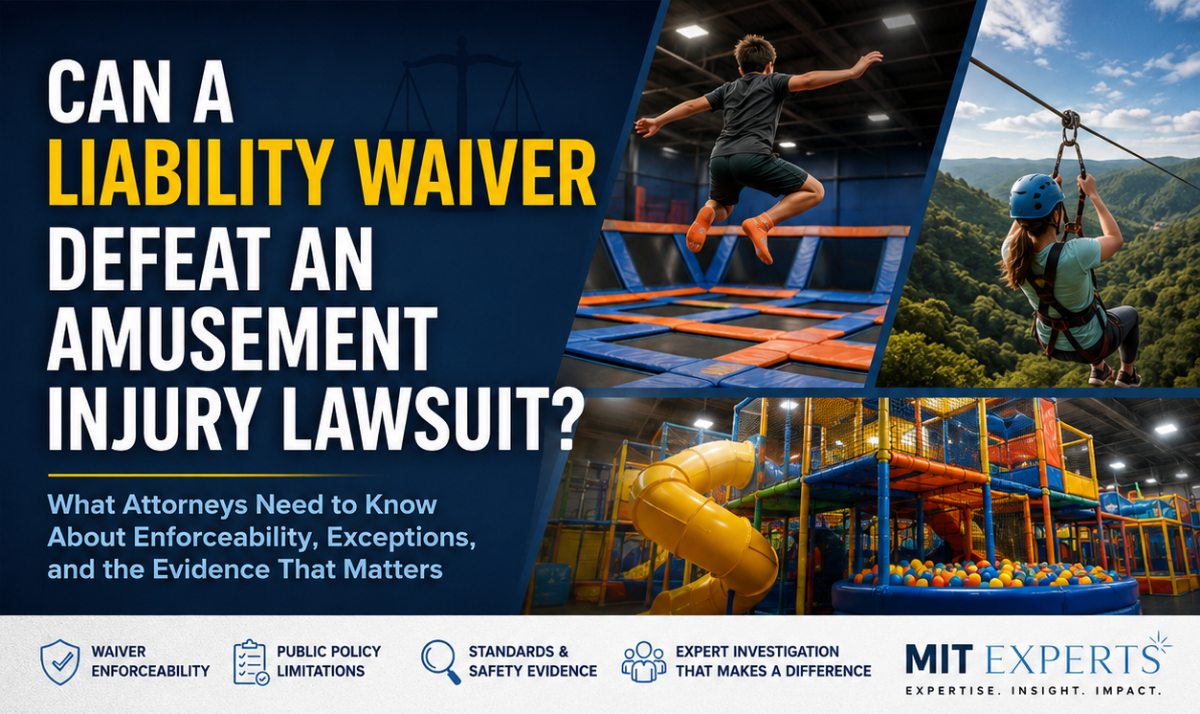
Can a Liability Waiver Defeat an Amusement Injury Lawsuit? Why the Answer Is Often More Complicated Than the Waiver Suggests
0 Comments