A serious leg fracture at an indoor trampoline park — and why the file still turns on contemporaneous evidence, the pleaded theory, and the right standard
In September 2026, Ireland’s High Court dismissed a personal-injuries claim arising from a serious trampoline-park injury. The case is Irish, not American. The lessons for U.S. counsel who handle commercial trampoline-court litigation are still direct: contemporaneous evidence can decide the case years later, the pleaded theory has to match the mechanism, and trampoline-court disputes usually require an expert who works from the right ASTM practice — typically ASTM F2970 for commercial trampoline courts — not a generic “amusement” label.
This post summarizes publicly reported facts from coverage of the judgment. It is not legal advice, and it does not purport to apply Irish law to U.S. dockets. It is offered for attorneys evaluating trampoline-park and trampoline-court files in the United States.
The reported facts
According to The Irish Times and subsequent legal commentary, Alex O’Leary was nine years old on November 2, 2018, when she suffered a right-leg fracture at an indoor trampolining park in Cork operated by Air-Tastic Cork Limited. The injury required surgery.> She was immobile for a period, progressing from a wheelchair to crutches, and later retained noticeable scarring below the right knee.
Through her father, she sued the operator. The judgment, published in September 2026 (reported as Alex O’Leary (A minor suing by her father and next friend Colin O’Leary) v Air-Tastic Cork Limited [2026] IEHC 615), dismissed the claim. Judge Barry O’Donnell found that the plaintiff had failed to establish negligence or breach of duty.
Public reporting emphasizes several points that matter to any trampoline-court file:
- The claim did not focus on the physical state of the facility, which the court accepted was of a high standard.
- The core theory was inadequate supervision, an unsafe form of trampolining, and insufficient care for the childs safety.
- The pleaded mechanism was that the child’s leg became trapped at the periphery of the trampoline — in the area where springs were attached — while she was jumping from trampoline to trampoline, causing a fall.
- The court found that padded walkways completely covered the spring mechanisms and that there were no exposed springs.
- CCTV showed circuits of trampolining. The court found as a fact that the child’s foot did not trap in or contact the padded border as pleaded, and that she did not land on or past the yellow border of the trampoline.
- The plaintiff’s recollection was described as honest but flawed — genuine, but contradicted by the CCTV.
- Criticism of supervision and warnings raised at trial that had not been pleaded did not assist the claim.
- Engineering evidence formed part of the record the court weighed alongside the video.
Costs orders were left for later. Nothing in the public coverage turns the injury into something trivial. It was a serious fracture. The dismissal turned on proof of breach and on how the case was framed against the evidence that survived the years between the incident and trial.
Why this matters in U.S. trampoline-court litigation
U.S. counsel will not cite an Irish High Court judgment as controlling authority. They will recognize the pattern.
First, contemporaneous evidence ages better than memory. Commercial trampoline parks generate CCTV, incident reports, opening and closing checklists, and sometimes engineering or maintenance records. When the gap between injury and trial stretches toward a decade, video and engineering materials often become the spine of the defense — or the gap plaintiff counsel must explain. Operators who fail to preserve that material invite a different set of problems. Counsel who fail to request it early invite a different set still.
Second, the pleaded mechanism has to survive the equipment. Border, padding, and spring-cover theories are common in trampoline-court complaints. So are collision, double-bounce, foam-pit, and court-layout theories. Each implies different discovery: padding condition and attachment, bed integrity, court design, capacity and supervision practices, rules enforcement, and whether the attraction was operated as a trampoline court or as something else under the same roof.
Third, trampoline park” is a marketing phrase, not an ASTM classification. In the United States, commercial trampoline courts are generally analyzed under ASTM F2970, the ASTM Committee F24 practice addressing design, manufacture, installation, operation, maintenance, inspection, and major modification of trampoline courts. Soft-contained indoor playgrounds are a different category (typically ASTM F1918). Inflatables are another. Hybrid family entertainment centers often mix several attractions under one waiver and one staff roster. The correct approach remains modular: identify the equipment involved in the incident, then apply the standard written for that equipment.
MIT Experts has written separately about why indoor-playground injuries should not be briefed as trampoline-park cases under F2970. The converse is equally true. A trampoline-court fracture at the bed border is not an F1918 soft-contained-play problem. Retaining the wrong expert, or building discovery around the wrong practice, produces opinions that do not match the attraction that injured the patron.
What ASTM F2970 brings to the file — without quoting the paywalled text
ASTM’s publicly described scope for F2970 is a practice for commercial trampoline courts under Committee F24 (Amusement Rides and Devices). Counsel should obtain the current edition of the ASTM safety standards and compare it to the manufacturer manuals, staff training, inspection logs, and operating procedures actually used at the facility. Industry standards do not automatically establish liability. Courts may, however, allow evidence of industry standards and custom as bearing on the standard of care. That is why the right document has to be in the working file before the expert is asked to write.
Do not paste dimensional requirements or other paywalled standard text into pleadings or reports. Use the published scope, the table of contents, and the operator’s own manuals to frame discovery. Then have an expert who actually works trampoline courts apply the practice to the facts.
Discovery that should be early, not late
In a U.S. trampoline-court case involving a claimed border, padding, or spring-cover mechanism — or any serious fracture on the court — useful early requests typically include:
- CCTV and other video covering the court and the time window of the incident, plus retention policies
- Incident reports, witness statements, and first-aid or EMS records created that day
- Manufacturer name, model, installation drawings, and the operations and maintenance manuals actually used
- Daily opening/closing checklists and inspection logs for beds, padding, springs/covers, and frame attachments
- Repair and replacement history for the bed or border involved
- Staffing and supervision assignments for the court that day; training materials and posted rules
- Capacity or patron-density practices on the court
- Prior complaints or incidents involving the same court or component
- Whether other attractions (foam pits, soft-contained play, inflatables) share staff and whether the correct standard was applied to each
Then compare those materials with ASTM F2970 and with how the case is pleaded. A theory that depends on exposed springs will not survive padding that fully covered them. A theory that depends on inadequate supervision will not survive if it was never pleaded. A theory that depends on trampoline-court practice will not survive an expert who only knows soft-contained play — or the reverse.
How MIT Experts approaches trampoline-court cases
MIT Experts is retained on trampoline-park, trampoline-court, zipline, and related amusement-injury matters for plaintiff and defense counsel, often with a trampoline park expert witness involved.
Peter Jay, J.D., M.B.A., is an ASTM F24 participant and a retained expert in amusement-industry litigation, with operational background in family entertainment environments that included trampoline features alongside soft-contained play.
That combination matters when the file turns on court design, padding and border conditions, supervision practices, and which ASTM document actually applies. Confidential case evaluation is available for attorneys handling trampoline-court and related attraction injuries.
Request a case evaluation: mitexperts.com/caseevaluation · (435) 272-2389 · contact@mitexperts.com
Sources for the public facts summarized above include The Irish Times (Sept. 11, 2026) and Kennedys’ JD Supra commentary (Sept. 14, 2026). This article does not reproduce proprietary ASTM standard text.
New Jersey's Appellate Division sends a child's trampoline park injury claim to arbitration, but strikes the release and indemnity clause
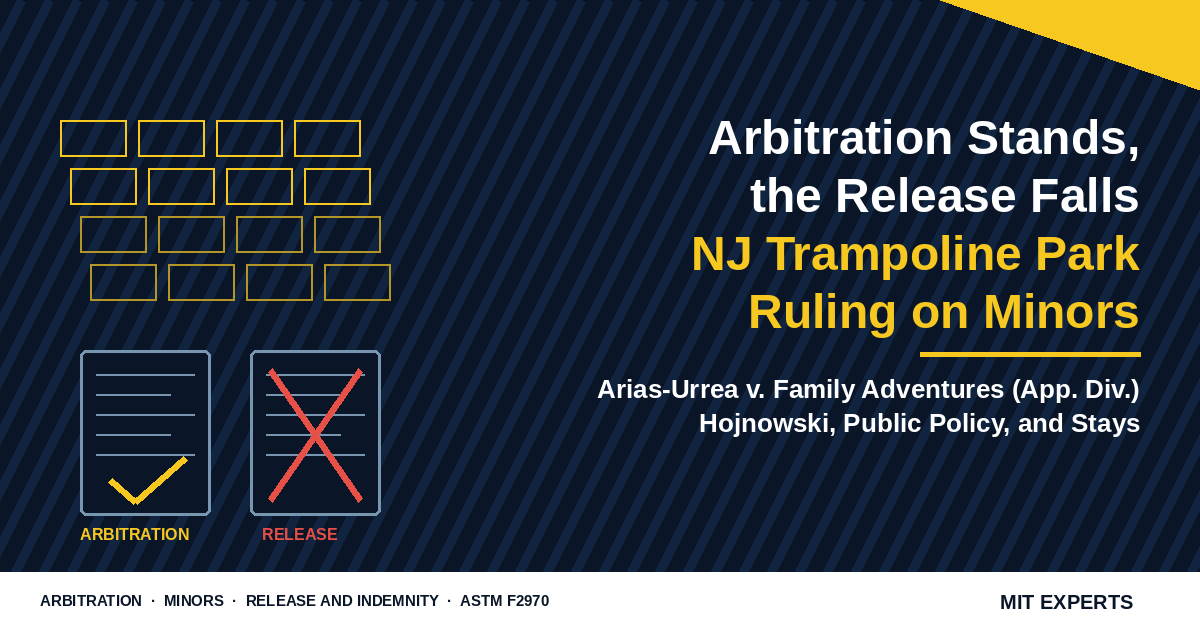
On September 30, 2026, the Appellate Division of the New Jersey Superior Court decided Arias-Urrea v. Family Adventures North Jersey, LLC, No. A-1382-25, a personal-injury case brought on behalf of a three-year-old who broke her leg while jumping on a trampoline at an Urban Air Trampoline & Adventure Park in South Hackensack. The per curiam opinion did three things at once. It held that the parents' signatures bound their daughter to arbitrate. It held that the agreement's release and indemnity provision is unenforceable as against New Jersey public policy. And it reversed the trial court's dismissal of the lawsuit, sending the case back for an order staying the court action while arbitration goes forward.
The opinion has been reported as unpublished, so under Rule 1:36-3 it is not binding precedent. It still matters. It applies settled New Jersey law to the kind of electronic waiver most trampoline parks use, and it shows how these cases are likely to unfold: the forum fight goes to the operator, the liability waiver goes to the child, and the case ends up being decided on the merits in front of an arbitrator. That makes the technical record, and the work of a qualified trampoline park injury expert witness, more important, not less.
Background
According to the opinion and New Jersey Courts Daily's report on it (the opinion makes no finding about how the injury happened or whether anyone was negligent):
- On January 22, 2023, before entering the park, both parents electronically signed an agreement that contained an arbitration provision and a jury-trial waiver. The court described the agreement as stating that the parents were waiving their child's right to bring a claim against the park's owners, employees, and agents, and that the child could pursue claims only through binding arbitration.
- The child, then three, broke her leg while jumping on a trampoline at the park.
- Her parents filed suit on her behalf in Hudson County on January 23, 2025. The defendants are Family Adventures North Jersey, LLC (doing business as the South Hackensack Urban Air park), UATP Management, LLC, Ari H. Moses, and Michael F. Karlewicz.
- On March 8, 2025, the defendants moved to compel arbitration and stay the case. According to the news report, the plaintiffs did not oppose the motion, and their counsel proposed dates and arbitrators.
- The trial court compelled arbitration but dismissed the complaint without prejudice instead of staying it. Two motions for reconsideration were denied.
What the court held
The arbitration provision binds the child. The court relied on Hojnowski v. Vans Skate Park, 187 N.J. 323 (2006). There, the New Jersey Supreme Court held that a parent cannot sign a pre-injury release of a minor's future tort claims arising from the use of a commercial recreational facility, but can bind the minor to arbitrate. As the Appellate Division explained, an agreement to arbitrate is not a waiver of the right to bring a claim; it only chooses the forum where the claim will be heard. Opening its analysis, the panel wrote that "a parent can waive a minor's right to go to court." It also cited its own decision in Perez v. Sky Zone LLC, 472 N.J. Super. 240 (App. Div. 2022), for the rule that an arbitration provision presented to a consumer entering a trampoline park is enforceable so long as it is clearly identified and clearly explained. The court found that the dispute resolution provision here met that standard. It also noted that the plaintiffs' argument that no agreement existed was not raised in response to the motion below.
The release and indemnity provision does not. The agreement's "Release and Indemnity" paragraph stated that the adult participant, on behalf of himself and the child participant, "releases, agrees not to sue, and shall indemnify and defend" Urban Air, UATP Management, the premises owner, and a long list of affiliated "protected parties." The court observed that the clause purports to let the defendants be indemnified by the parents for their own daughter's personal-injury damage award. New Jersey Courts Daily quotes the panel's holding: "We hold that the Release and Indemnity provision contained in the agreement is unenforceable and against New Jersey's public policy."
The court action must be stayed, not dismissed. Both the Federal Arbitration Act and the New Jersey Arbitration Act direct courts to stay judicial proceedings once claims are sent to arbitration. The panel found it unnecessary to decide which statute applied, noting that whether a visit to a New Jersey trampoline park involves interstate commerce is "a debatable point," because the result is the same under either. It reversed the dismissal and remanded for an order compelling arbitration and staying the Law Division action.
Why this split matters to both sides
Trampoline park agreements usually bundle several clauses together: an assumption of risk, a release, an indemnity, and a dispute resolution clause. Arias-Urrea is a reminder that New Jersey courts take those clauses one at a time.
For defense counsel, the decision confirms that a clearly drafted arbitration clause signed by a parent will usually hold up, and that the operator can get the forum it bargained for. It also confirms the limit: in New Jersey, the release will not defeat a child's negligence claim, and an indemnity clause that would make parents pay for their own child's recovery is not going to be enforced. A motion strategy that leans on the release, or a settlement posture that counts on indemnity leverage against the parents, should be reconsidered early.
For plaintiff counsel, the decision means the child's claims survive, but they will probably be heard by an arbitrator rather than a jury. That changes how the case gets built. Arbitrators often decide cases on a tighter schedule and with less discovery than a court, so the plaintiff's liability theory needs to be organized and documented sooner. Counsel should also review the signing record carefully. Both parents signed here, and the plaintiffs did not contest formation in the trial court, which narrowed their options on appeal.
The merits still turn on operations and standards
Once the release is off the table, a trampoline injury case becomes an ordinary negligence dispute about how the park was designed, staffed, supervised, and maintained. The industry practice for trampoline courts is ASTM F2970, which by its title covers the design, manufacture, installation, operation, maintenance, inspection, and major modification of trampoline courts.
Counsel on either side should get the current edition of F2970 directly from ASTM and compare it to the facility's own manuals, training materials, and logs, rather than relying on secondary summaries. Opinions grounded in ASTM safety standards and the specific facility record tend to persuade arbitrators far more than general statements that a park was "unsafe."
What to gather early
- The full signing record: every electronic agreement tied to the visit, with timestamps, signer identity, the screens as presented on the kiosk or app, and font and layout as displayed, since clarity of presentation is part of the Perez analysis.
- Arbitration terms: the administering body and rules referenced in the agreement, fee allocation, and any discovery limits.
- CCTV of the court and surrounding area, plus the park's retention policy and any preservation letters.
- Staffing and supervision records: schedules, court monitor assignments, and training records for the day of the incident.
- Operations materials: manufacturer manuals, park rules, signage, safety videos, and any policies on separating jumpers by age or size.
- Incident reports for the event and prior incidents on the same court or attraction.
Because the arbitrator will decide the merits, a trampoline park expert witness retained early can help counsel decide what records to request and frame the operations questions before the arbitration schedule tightens.
How MIT Experts helps
MIT Experts is retained by plaintiff and defense counsel on trampoline-park and related amusement-injury matters, in court and in arbitration. Peter Jay, J.D., M.B.A., is an ASTM F24 participant who has owned and operated indoor family entertainment venues. That background supports opinions grounded in the standard and in how these attractions are actually staffed, supervised, and maintained.
Confidential case evaluation is available for attorneys handling trampoline park injury claims involving children.
Request a case evaluation: mitexperts.com/caseevaluation · (435) 272-2389 · contact@mitexperts.com
Sources and disclaimer
Facts in this article come from the per curiam opinion in Arias-Urrea v. Family Adventures North Jersey, LLC, No. A-1382-25 (N.J. Super. Ct. App. Div. Sept. 30, 2026), and from New Jersey Courts Daily's report on it ("Parents of injured child accuse trampoline park operator of enforcing invalid waiver and arbitration agreement," Oct. 7, 2026). The opinion's unpublished status is as reported by legal news summaries; under Rule 1:36-3, unpublished opinions do not constitute precedent. The quoted holding on the release and indemnity provision is as quoted by New Jersey Courts Daily. Hojnowski and Perez are described as the Arias-Urrea opinion characterizes them. The opinion makes no finding of negligence or liability. This article is for informational purposes for attorneys. It is not legal advice and does not reproduce proprietary ASTM standard text.


0 Comments