Indoor Playground Injuries Are Not Trampoline-Park Cases
Why ASTM F1918 is usually the standard that actually applies
When a child is injured in a padded, enclosed play structure at a family entertainment center, mall play area, or indoor playground, the file often arrives labeled as an “amusement” case or a “trampoline park” case.
That label can send the investigation in the wrong direction.
Soft-contained play equipment — tube slides, climbing frames, ball pits, netted corridors, and multi-level padded structures — is its own category of equipment. It has its own ASTM standard: ASTM F1918, Standard Safety Performance Specification for Soft Contained Play Equipment.
It is not ASTM F2970 (trampoline courts). It is not ASTM F1487 (public playground equipment). And F1918’s own scope expressly excludes amusement rides.
For plaintiff and defense counsel, using the wrong standard is not a technical quibble. It can produce the wrong discovery, the wrong expert, and a standard-of-care opinion that does not match the equipment that actually injured the child.
What “soft-contained play” actually is
Soft-contained play equipment (often abbreviated SCPE) is the enclosed indoor play system most lawyers have walked past in a mall or birthday-party venue: padded platforms, plastic tunnels, slides, cargo nets, and ball pits, typically wrapped in netting or fabric so children play inside the structure rather than around it.
These facilities are marketed as indoor playgrounds, play cafés, or family entertainment centers. The marketing name does not determine the standard. The equipment does.
MIT Experts’ own operational background is in this environment. Peter Jay owned and operated indoor playgrounds built from soft-contained play equipment for nearly a decade — two locations and a franchise, roughly 4,000 square feet, serving on the order of 275,000 visitors — including design collaboration with manufacturers, ASTM compliance in daily operations, staff training, and maintenance programs.
What ASTM F1918 covers — and what it doesn’t
The current edition is ASTM F1918-21. It is a safety performance specification, developed by ASTM Committee F15 on Consumer Products, Subcommittee F15.36 on Soft-Contained Play Systems. It was originally approved in 1998.
ASTM’s published scope is unusually useful in litigation because it states, in the standard’s own words, what the document is and is not:
- Its purpose is to reduce the potential for life-threatening and debilitating injuries.
- The intended user range is the 5th percentile 2-year-old through the 95th percentile 12-year-old.
- It does not include public playground equipment, home playground equipment, sports equipment, amusement rides, fitness equipment that is not part of the play system, water-related attractions and devices, or toys and juvenile products.
The table of contents is equally revealing. F1918 is not only a design spec. It includes sections on materials and manufacture, performance requirements, access and egress, equipment, areas outside the equipment, structural integrity, maintenance, fire safety, and evacuation.
Those last items are where indoor-playground cases often actually live — and where a trampoline-court or outdoor-playground analysis tends to go silent.
The three-standard trap
Counsel, and the experts they retain, commonly reach for one of three documents. Only one of them usually belongs.
ASTM F1918-21 — soft contained play equipment. Committee F15. A consumer-product safety performance specification. Indoor enclosed play systems. Intended user range ages 2–12.
ASTM F2970-25 — trampoline courts. Committee F24 (Amusement Rides and Devices). A practice covering design, manufacture, installation, operation, maintenance, inspection, and major modification of commercial trampoline courts. If the injury happened on a trampoline court, F2970 is the starting point. If it happened in a tube slide, ball pit, or enclosed climbing structure, it is not.
ASTM F1487-25 — playground equipment for public use. Also Committee F15, but written for public playgrounds — parks, schools, municipal equipment — with use-zone and surfacing analysis that assumes open play, not a fully enclosed indoor system.
A fourth mix-up appears when the venue also has bounce houses or other inflatable attractions. Those are generally analyzed under ASTM F2374 (inflatable amusement devices), not F1918.
F1918 says amusement rides are outside its scope. F2970 is an F24 amusement practice. Treating a padded indoor play structure as if it were an amusement ride, or as if it were a trampoline court, is how opinions get built on the wrong foundation.
The committee difference is not academic. F24 practices are written around owner/operator programs, patron education, and amusement operations. F15 performance specifications are written around equipment hazards: entrapment, entanglement, protrusions, materials, access and egress, fire, and evacuation. The questions you ask in discovery should follow the document that actually applies.
Why the wrong standard changes the case
Age. F1918 is written for children from 2 through 12. A toddler under 2 in a structure designed and labeled for that range, or a teenager in the same structure, is not a “kids will be kids” footnote. It is a scope fact. Age-banding, posted rules, and whether the operator enforced them become central.
The mechanism of injury. Indoor SCPE injuries often involve entrapment or entanglement in netting and openings, falls from internal platforms, slide-exit conditions, collisions inside enclosed corridors, degraded foam or impact-absorbing materials, overcrowding, or a child who could not get out. Those are F1918 issues. They are not “failed to pad a trampoline frame” issues.
Maintenance and inspection. F1918 includes a maintenance section. Manufacturer manuals for SCPE typically require periodic inspection of netting, connectors, padding, slide beds, and structural attachments. If the working file is built around F2970, those records may never be requested.
Fire and evacuation. Enclosed play systems create a hazard that open trampoline courts and outdoor playgrounds do not: children inside a multi-level structure who must get out. F1918 includes fire-safety and evacuation sections. In a smoke, crowding, or emergency-egress case, a trampoline-court analysis will miss the issue.
Daubert / Rule 702. An expert who applies trampoline-court practice to a soft-contained play structure is opining outside the standard that governs the equipment. That is a methodology problem, not just a disagreement about the facts.
Hybrid facilities make this worse, not better
Many modern venues mix attractions under one roof: a soft-contained playground, a small trampoline area, an inflatable, a café, party rooms.
One waiver. One staff. One brand name. Several standards.
The correct approach is modular. Identify the equipment involved in the incident, then apply the standard written for that equipment. A family entertainment center is not a single ASTM classification.
Peter Jay’s own facilities combined soft-contained play with small trampoline features. That is common. It is also why a one-standard report is often incomplete.
What counsel should obtain early
In an indoor-playground injury case, the useful first requests usually include:
- Manufacturer name, model, and installation drawings for the play system
- The operations and maintenance manual actually used — not a generic industry pamphlet
- Age recommendations and how they were posted and enforced
- Daily opening/closing checklists and inspection logs
- Repair, replacement, and incident records for the component involved (netting, slide, platform, ball pit, connectors)
- Staff training materials and supervision assignments for the play structure
- Occupancy or capacity practices inside the structure
- Any prior complaints involving the same component
- Whether trampoline courts, inflatables, or outdoor-playground equipment share the same floor and the same staff
Then compare those materials with ASTM F1918-21 — not with the standard the operator’s insurer happens to know.
Industry standards do not automatically establish liability. Courts may, however, permit evidence of industry standards and custom as bearing on the standard of care. That is why the right standard has to be in the file before the expert is asked to write.
How MIT Experts approaches these cases
MIT Experts is often retained on trampoline-park and zipline matters. Indoor playgrounds are a different practice, and they are a substantial part of how the firm actually operated.
Peter Jay, J.D., M.B.A., owned and operated indoor playgrounds constructed from soft-contained play equipment. He is also an ASTM F24 participant and a retained expert in amusement-industry litigation.
That combination matters in SCPE cases: the standard that applies is a consumer-product performance specification, but the defendant is usually an operator. Someone has to be able to speak to both the equipment and how these businesses are actually run.
MIT Experts provides confidential case evaluation for plaintiff and defense counsel, including standard-of-care analysis, discovery support, and expert reporting. Attorneys handling an indoor-playground injury are invited to request a case evaluation at mitexperts.com/caseevaluation.
New Jersey's Appellate Division sends a child's trampoline park injury claim to arbitration, but strikes the release and indemnity clause
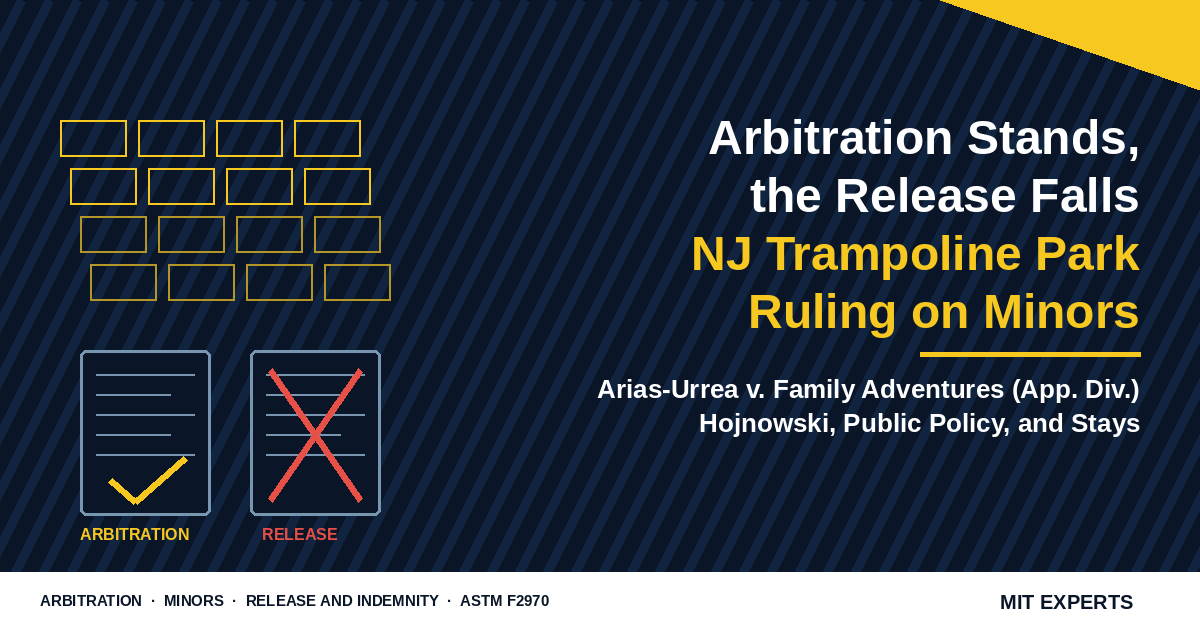
On September 30, 2026, the Appellate Division of the New Jersey Superior Court decided Arias-Urrea v. Family Adventures North Jersey, LLC, No. A-1382-25, a personal-injury case brought on behalf of a three-year-old who broke her leg while jumping on a trampoline at an Urban Air Trampoline & Adventure Park in South Hackensack. The per curiam opinion did three things at once. It held that the parents' signatures bound their daughter to arbitrate. It held that the agreement's release and indemnity provision is unenforceable as against New Jersey public policy. And it reversed the trial court's dismissal of the lawsuit, sending the case back for an order staying the court action while arbitration goes forward.
The opinion has been reported as unpublished, so under Rule 1:36-3 it is not binding precedent. It still matters. It applies settled New Jersey law to the kind of electronic waiver most trampoline parks use, and it shows how these cases are likely to unfold: the forum fight goes to the operator, the liability waiver goes to the child, and the case ends up being decided on the merits in front of an arbitrator. That makes the technical record, and the work of a qualified trampoline park injury expert witness, more important, not less.
Background
According to the opinion and New Jersey Courts Daily's report on it (the opinion makes no finding about how the injury happened or whether anyone was negligent):
- On January 22, 2023, before entering the park, both parents electronically signed an agreement that contained an arbitration provision and a jury-trial waiver. The court described the agreement as stating that the parents were waiving their child's right to bring a claim against the park's owners, employees, and agents, and that the child could pursue claims only through binding arbitration.
- The child, then three, broke her leg while jumping on a trampoline at the park.
- Her parents filed suit on her behalf in Hudson County on January 23, 2025. The defendants are Family Adventures North Jersey, LLC (doing business as the South Hackensack Urban Air park), UATP Management, LLC, Ari H. Moses, and Michael F. Karlewicz.
- On March 8, 2025, the defendants moved to compel arbitration and stay the case. According to the news report, the plaintiffs did not oppose the motion, and their counsel proposed dates and arbitrators.
- The trial court compelled arbitration but dismissed the complaint without prejudice instead of staying it. Two motions for reconsideration were denied.
What the court held
The arbitration provision binds the child. The court relied on Hojnowski v. Vans Skate Park, 187 N.J. 323 (2006). There, the New Jersey Supreme Court held that a parent cannot sign a pre-injury release of a minor's future tort claims arising from the use of a commercial recreational facility, but can bind the minor to arbitrate. As the Appellate Division explained, an agreement to arbitrate is not a waiver of the right to bring a claim; it only chooses the forum where the claim will be heard. Opening its analysis, the panel wrote that "a parent can waive a minor's right to go to court." It also cited its own decision in Perez v. Sky Zone LLC, 472 N.J. Super. 240 (App. Div. 2022), for the rule that an arbitration provision presented to a consumer entering a trampoline park is enforceable so long as it is clearly identified and clearly explained. The court found that the dispute resolution provision here met that standard. It also noted that the plaintiffs' argument that no agreement existed was not raised in response to the motion below.
The release and indemnity provision does not. The agreement's "Release and Indemnity" paragraph stated that the adult participant, on behalf of himself and the child participant, "releases, agrees not to sue, and shall indemnify and defend" Urban Air, UATP Management, the premises owner, and a long list of affiliated "protected parties." The court observed that the clause purports to let the defendants be indemnified by the parents for their own daughter's personal-injury damage award. New Jersey Courts Daily quotes the panel's holding: "We hold that the Release and Indemnity provision contained in the agreement is unenforceable and against New Jersey's public policy."
The court action must be stayed, not dismissed. Both the Federal Arbitration Act and the New Jersey Arbitration Act direct courts to stay judicial proceedings once claims are sent to arbitration. The panel found it unnecessary to decide which statute applied, noting that whether a visit to a New Jersey trampoline park involves interstate commerce is "a debatable point," because the result is the same under either. It reversed the dismissal and remanded for an order compelling arbitration and staying the Law Division action.
Why this split matters to both sides
Trampoline park agreements usually bundle several clauses together: an assumption of risk, a release, an indemnity, and a dispute resolution clause. Arias-Urrea is a reminder that New Jersey courts take those clauses one at a time.
For defense counsel, the decision confirms that a clearly drafted arbitration clause signed by a parent will usually hold up, and that the operator can get the forum it bargained for. It also confirms the limit: in New Jersey, the release will not defeat a child's negligence claim, and an indemnity clause that would make parents pay for their own child's recovery is not going to be enforced. A motion strategy that leans on the release, or a settlement posture that counts on indemnity leverage against the parents, should be reconsidered early.
For plaintiff counsel, the decision means the child's claims survive, but they will probably be heard by an arbitrator rather than a jury. That changes how the case gets built. Arbitrators often decide cases on a tighter schedule and with less discovery than a court, so the plaintiff's liability theory needs to be organized and documented sooner. Counsel should also review the signing record carefully. Both parents signed here, and the plaintiffs did not contest formation in the trial court, which narrowed their options on appeal.
The merits still turn on operations and standards
Once the release is off the table, a trampoline injury case becomes an ordinary negligence dispute about how the park was designed, staffed, supervised, and maintained. The industry practice for trampoline courts is ASTM F2970, which by its title covers the design, manufacture, installation, operation, maintenance, inspection, and major modification of trampoline courts.
Counsel on either side should get the current edition of F2970 directly from ASTM and compare it to the facility's own manuals, training materials, and logs, rather than relying on secondary summaries. Opinions grounded in ASTM safety standards and the specific facility record tend to persuade arbitrators far more than general statements that a park was "unsafe."
What to gather early
- The full signing record: every electronic agreement tied to the visit, with timestamps, signer identity, the screens as presented on the kiosk or app, and font and layout as displayed, since clarity of presentation is part of the Perez analysis.
- Arbitration terms: the administering body and rules referenced in the agreement, fee allocation, and any discovery limits.
- CCTV of the court and surrounding area, plus the park's retention policy and any preservation letters.
- Staffing and supervision records: schedules, court monitor assignments, and training records for the day of the incident.
- Operations materials: manufacturer manuals, park rules, signage, safety videos, and any policies on separating jumpers by age or size.
- Incident reports for the event and prior incidents on the same court or attraction.
Because the arbitrator will decide the merits, a trampoline park expert witness retained early can help counsel decide what records to request and frame the operations questions before the arbitration schedule tightens.
How MIT Experts helps
MIT Experts is retained by plaintiff and defense counsel on trampoline-park and related amusement-injury matters, in court and in arbitration. Peter Jay, J.D., M.B.A., is an ASTM F24 participant who has owned and operated indoor family entertainment venues. That background supports opinions grounded in the standard and in how these attractions are actually staffed, supervised, and maintained.
Confidential case evaluation is available for attorneys handling trampoline park injury claims involving children.
Request a case evaluation: mitexperts.com/caseevaluation · (435) 272-2389 · contact@mitexperts.com
Sources and disclaimer
Facts in this article come from the per curiam opinion in Arias-Urrea v. Family Adventures North Jersey, LLC, No. A-1382-25 (N.J. Super. Ct. App. Div. Sept. 30, 2026), and from New Jersey Courts Daily's report on it ("Parents of injured child accuse trampoline park operator of enforcing invalid waiver and arbitration agreement," Oct. 7, 2026). The opinion's unpublished status is as reported by legal news summaries; under Rule 1:36-3, unpublished opinions do not constitute precedent. The quoted holding on the release and indemnity provision is as quoted by New Jersey Courts Daily. Hojnowski and Perez are described as the Arias-Urrea opinion characterizes them. The opinion makes no finding of negligence or liability. This article is for informational purposes for attorneys. It is not legal advice and does not reproduce proprietary ASTM standard text.


0 Comments